Mobile App Development in Kocaeli

We build mobile applications for companies in Kocaeli, and they fall into two groups that have almost nothing in common. Internal apps make the work of people who are not sitting at a desk faster and more accurate. External apps put the business in the hands of its customers. Confusing the two is the most common way a mobile budget gets wasted.

  • Scope in writing

    What will be built, when it ships and what is out of scope — agreed before production starts.

  • You stay in control

    Every project ships with an admin panel so you can update content yourself.

  • Support after launch

    Small fixes are covered by the support scope of the package you choose.

What a mobile app is actually for in an industrial setting

The need we meet most often around here is data entry by people who are nowhere near a computer. Someone counting stock in a warehouse, servicing a machine on site, loading a dispatch or recording output during a shift. Until they get back to a desk and type it into a file, the information is either late or gone.

An application like that is not judged on how it looks. It is judged on whether it can be used quickly with one hand. Scan a barcode, attach a photograph, fill two fields, save. Inside a plant where the signal drops behind thick walls, working offline and synchronising when the connection returns is usually not a nice extra but the entire point.

The second common case is service and maintenance tracking: which job the technician attended, what was done, which part was replaced, where the customer signed. When that moves off paper forms and onto a phone, two things improve at once. The record survives, and invoicing stops waiting for a folder to come back to the office.
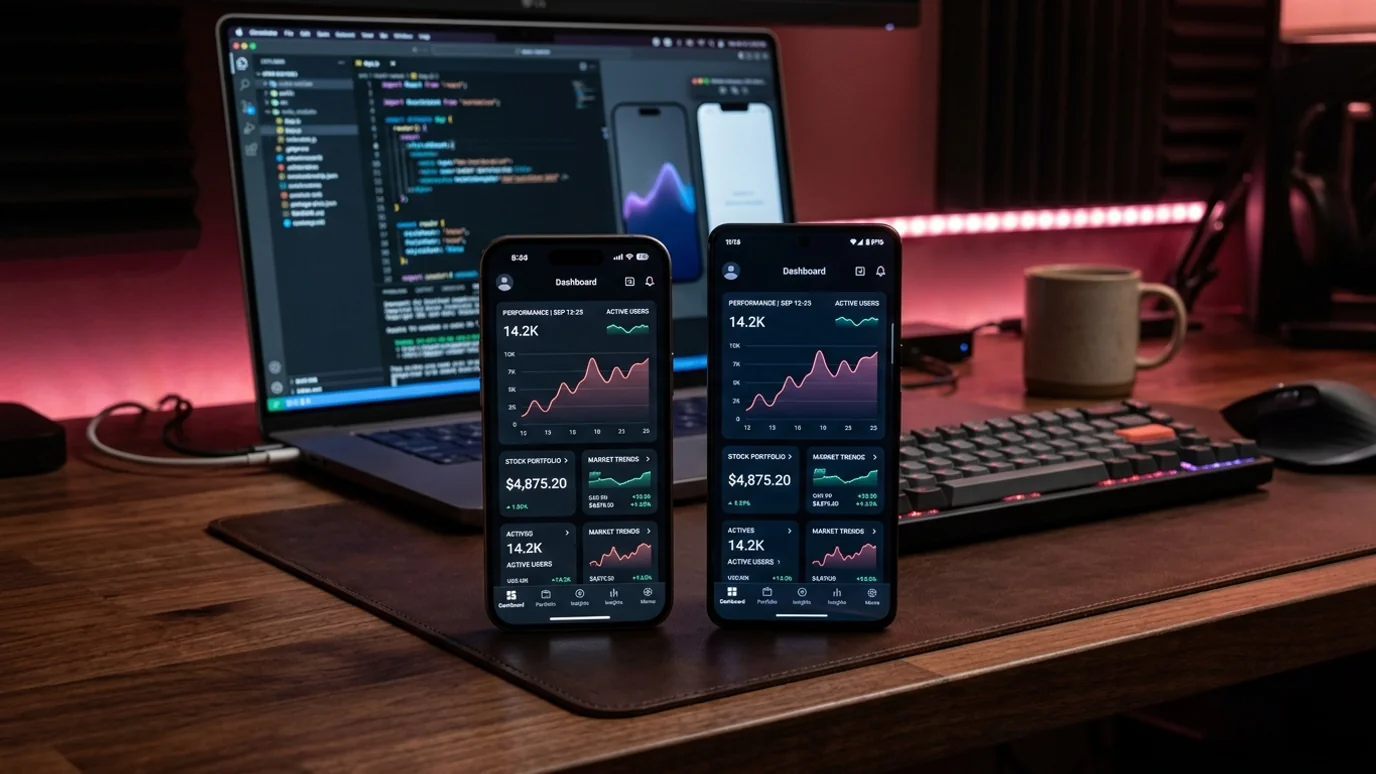
The same mobile application shown on iOS and Android devices
One codebase feeding both stores: for a small team the difference shows up mostly in what maintenance costs each year.

Do you need an app, or a good mobile site?

We raise this at the start of every enquiry, because the answer is frequently no, and saying so costs us work.

If a person deals with you a few times a year, they will not install anything. Showing a menu, taking a booking, publishing a price list or letting someone request a quote all work better on a mobile web page: nothing to download, no store review standing between you and a correction, and a fraction of the cost.

An app earns its place in three situations. The user comes back often enough to keep it on their phone. The job needs the device itself, meaning the camera for scanning, location, offline storage or push notifications. Or the app is a work tool that an employee opens every single day.

We make that call together, with the cheaper option on the table. An app that nobody installs is a worse outcome than an app that was never built.

Building it, and getting it into the stores

We start by settling the scope and the screens. Which user completes which task, in how many taps. Drawing that first is far cheaper than adding screens later, when every addition drags a dozen other decisions behind it.

Development is delivered in pieces. The most important flow becomes usable first, you try it on a real device in the place it will be used, and the rest follows the feedback rather than the original guess.

Store publication is the step that catches most companies out. Apple and Google each run their own review, and an app with no privacy policy, no data usage declaration or no account deletion path is rejected regardless of how well it works. We plan for those requirements at the beginning so that the delivery week is not spent rewriting policy documents.

Developer accounts are opened in your name. The app is your asset, and if you ever work with someone else, the store listing, the reviews and the install base have to stay with you.

The maintenance nobody budgets for

Unlike a website, a mobile app is not finished when it is finished. iOS and Android release a major version every year, the stores introduce new requirements at their own pace, and an app that is never updated eventually stops being accepted or stops working on new handsets.

We say this before the project starts, because it belongs in the budget rather than in a surprise conversation later. Annual developer account fees, compatibility updates and occasional store policy changes are all predictable items, even if their exact timing is not.

It also shapes the technology we choose. For a company without an in-house mobile team, the right answer is a structure that one maintainer can keep alive from a single codebase, not the most fashionable stack of the year.

Our work in Kocaeli

We work with manufacturing and service companies around Kocaeli. On the mobile side the recurring work is field data entry, warehouse counting and service tracking; on the customer-facing side it is ordering and loyalty. During a first call we can point to the examples closest to what you are describing.

Pricing and packages

from97,100TL

Mobile Application Solutions packages start here. Scope, timeline and the final quote are set after we talk about your project.

Frequently asked questions

The questions we hear most about Mobile Application Solutions in Kocaeli.

Do iOS and Android have to be built separately?

Usually not. We work cross-platform, so one codebase serves both stores, which lowers both the build cost and the ongoing maintenance. Where an app leans heavily on device hardware or needs platform-specific behaviour, native development can still be the right call, and if your idea falls into that category we say so in the first conversation rather than after the quote.

The signal inside our plant is poor. Will the app still work?

That is designed in from the start. For warehouse and field applications, offline operation is close to mandatory: records are held on the device and synchronised with the server when the connection comes back. In an environment where a dropped connection must not stop work, this is a basic requirement rather than a feature.

Can it talk to the software we already run?

If your existing system allows data exchange, yes. We check which software you use and whether the integration is technically possible before the project begins. If it is not possible, you hear that at the start, and we look at what can be done instead.

Do we have to publish it in the app stores?

No. An app that only your own staff will use can be distributed outside the public stores, which avoids the review process and some of its requirements. Which route suits you depends on how many devices are involved and how they are managed, and we work that out with you rather than defaulting to a store listing.

Looking for Mobile Application Solutions in Kocaeli?

Tell us what you have in mind and we will tell you whether it really needs an app, and if it does, roughly what the scope and the timeline look like.