E-Commerce Setup in Istanbul

We set up online stores for brands based in Istanbul. The visible part of this work is the smaller part. What decides whether a store earns its keep is whether products, stock, shipping and payment have been arranged correctly behind it.

  • Scope in writing

    What will be built, when it ships and what is out of scope — agreed before production starts.

  • You stay in control

    Every project ships with an admin panel so you can update content yourself.

  • Support after launch

    Small fixes are covered by the support scope of the package you choose.

The flow sells, not the styling

The most common misconception we meet is that conversion is a design problem. It rarely is. Somebody who abandons a basket almost never leaves because they disliked a colour. They leave because something blocked them on the way to paying.

A shipping charge appearing as a surprise at the final step. Registration being forced on a first-time buyer. A phone field rejecting a perfectly valid number. A card step that takes four seconds to load on a phone. Each of these is money leaving, and removing one of them typically does more for revenue than a full redesign would.

So a project starts with the product and order flow rather than with layouts. How many products, how many variants, where stock is managed, how shipping is calculated, how a return is processed, who packs the order and when. The design is then built on top of decisions that have already been made, instead of being decorated around problems discovered later.

Storefront page of an e-commerce site selling gifts and experiences
Storefront, filtering and basket flow: the real task is reducing the number of steps between finding a product and paying for it.

An existing platform, or something built for you

For most brands here the right answer is a well-configured store on an established platform, and we say so plainly. If your sales model is conventional, commissioning software from nothing is both more expensive and a needless risk, since you would be paying to rebuild problems other people solved years ago.

Custom development becomes reasonable in specific circumstances. Your product structure is not standard, meaning made to measure, configurable bundles or subscriptions. You need deep integration with an existing enterprise system rather than a nightly file exchange. Or your sales process genuinely differs from your competitors and that difference is why customers choose you.

We work out which case applies by looking at your product count, order volume and how your operation actually runs day to day. Where a platform will do the job, we set it up properly rather than talking you into a project.

The items that get overlooked until they hurt

Payment infrastructure: the application and contract process for a virtual POS runs on the bank's schedule and can take weeks. It has to be started at the beginning of the calendar, otherwise the store sits finished and unable to take money.

Legal texts: distance selling terms, returns and delivery conditions, privacy and data protection notices. These are not decoration. Missing texts are both a legal exposure and, quite often, a reason a payment provider declines to approve the account.

Product data: photographs, descriptions, variants and stock figures. This is almost always the item that delays a launch, so we agree at the start how many products you will open with and what condition the data is in.

Measurement: knowing which channel brought which sale. Spending on advertising before that exists is spending in the dark, and it is remarkable how often a store starts advertising in exactly that state.

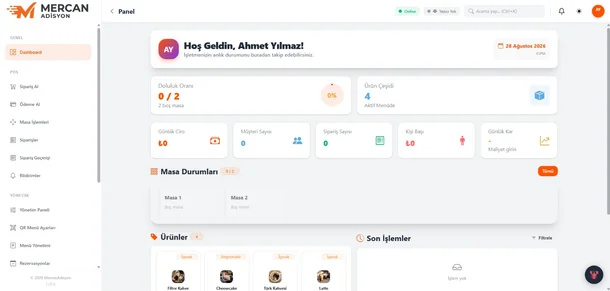
Admin panel screen tracking orders and stock movements
Orders, stock and customer records in one panel, so daily operations do not need to pass through the agency.

The first weeks after opening

Unlike a corporate site, an online store begins its real life on launch day. Watching how actual customers behave in the first weeks and fixing what blocks them is worth more than any amount of pre-launch theorising, because real buyers do things no planning session predicts.

Adding products, setting up promotions and managing orders are done by you through the panel, and we go through it together at handover. Depending on an agency for daily operations is a bad arrangement for both sides; it makes you slow and it makes us a bottleneck.

Domain, hosting and payment provider accounts are opened in your name. These are business assets, and they need to stay with the business regardless of who builds the next version of the store.

Logistics and competition, the Istanbul version

Selling from Istanbul carries a genuine advantage: dispatch is quick, same-day delivery options exist, and suppliers are close. That advantage affects customer experience directly, and it should be visible on the site rather than left as an internal fact.

Stating the delivery window on the product page, showing the shipping cost before the basket rather than after it, and running a tracking flow that reflects reality are operational decisions rather than design ones, and their effect on conversion is larger than most visual work.

On the competitive side, it has to be accepted that a price comparison is one tab away. A store competing only on price has a difficult life ahead of it, because someone will always go lower. The separation happens elsewhere: the quality of product descriptions, honest photography, a return process that does not punish the customer, and being reachable after the sale.

The site needs somewhere to say all of that. In most stores the About page is an empty formality, and the one thing the brand most needs to communicate quietly disappears there.

Our work in Istanbul

We work with retail and direct-to-consumer brands operating out of Istanbul, on stores of a range of sizes. The scope, the launch checklist and the division of responsibilities are written down before the build starts, and the payment provider and hosting accounts stay in the client's own name throughout.

Pricing and packages

from20,200TL

Corporate Web Solutions packages start here. Scope, timeline and the final quote are set after we talk about your project.

Frequently asked questions

The questions we hear most about Corporate Web Solutions in Istanbul.

How many products should we launch with?

There is no limit, but in our experience opening with fewer products that have complete data beats loading hundreds with gaps. A product with no photograph or half a description does not sell, and worse, it lowers confidence in the rest of the store. Start with what is ready and add the rest as the data is completed.

We also sell on marketplaces. Can that be integrated?

It depends on what your chosen platform supports. Stock synchronisation is the part that matters most: selling the same unit on two channels and then cancelling the order produces refunds and bad reviews at the same time. That is why we ask which channels you are on during the first conversation rather than after the build.

Do you handle the virtual POS application?

The application is made in the name of the business, so it has to come from you. We handle the technical integration and guide you on which documents will be requested. We also flag at the start that the bank side can take weeks, so the launch date is planned around it instead of colliding with it.

Will sales start once the store is live?

Not on their own, and we would rather say that before you spend the money. Traffic arrives through advertising, through organic visibility built over time, or from an audience you already have. The store's job is to convert whoever arrives with as little friction as possible. If there is no plan for where the visitors come from, that is a conversation to have before launch rather than after a quiet first month.

Looking for Corporate Web Solutions in Istanbul?

Tell us about your product structure and how you sell, and we will tell you whether an established platform covers it or whether your case genuinely calls for custom work.