Custom Software and Business Applications in Sakarya

We develop software that follows how a business in Sakarya already operates, instead of asking it to reorganise around a package. In most of these projects the information already exists somewhere. It is simply scattered, late, and known to only one person.

  • Scope in writing

    What will be built, when it ships and what is out of scope — agreed before production starts.

  • You stay in control

    Every project ships with an admin panel so you can update content yourself.

  • Support after launch

    Small fixes are covered by the support scope of the package you choose.

Which processes here tend to need software

In the automotive supplier tier, the request we hear most often is traceability. A company supplying a large manufacturer has to be able to show which batch a part came from, which inspection it passed and who signed for it. Kept in spreadsheets, that record is both easy to get wrong and awkward to defend when a customer sends someone to look at it.

In agricultural machinery and equipment manufacturing the need is usually order and assembly tracking. Which order is at which stage, which component is still missing, what the realistic delivery date now is. Because production advances unit by unit rather than in continuous batches, ordinary stock software models it poorly and people end up keeping a private list alongside the official one.

On the hospitality side around Sapanca, availability and channel management dominate. Most properties sell through more than one platform at once, and availability drifting out of sync turns directly into cancellations, refunds and a review nobody wanted.

What these three have in common is not complexity. It is timing. The software is not there to produce new information; it is there to collect what already exists, in one place, while it still matters.
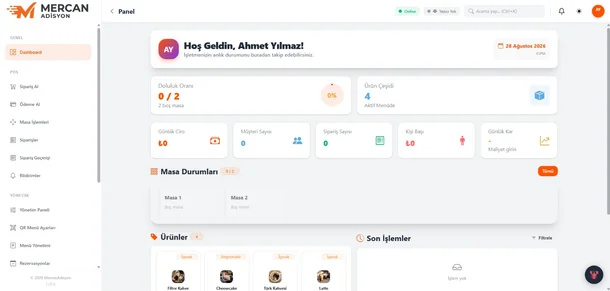
Admin panel screen tracking orders and production status
One panel instead of several files, with permission levels arranged to match how the business actually runs.

When an existing program is enough

We put this question first in every enquiry, because more often than not the answer is that you do not need anything built.

If what you do is standard, meaning ordinary stock movements, conventional invoicing and normal account tracking, a package on the market will handle it sooner and for less. We are not going to quote a development project against a problem that has already been solved a thousand times.

Building something makes sense when your process departs from the norm and that departure is how you work. Manufacturing to measure, batch-level traceability with your customer's own record requirements, a calculation rule you developed yourself, an assembly sequence no package represents.

The question that decides it is worth asking out loud: to use the package, would you have to change the way you work? If yes, that is the point at which building something specific stops being an indulgence.

How a project runs

It starts with looking at the process where it happens. Who records what, on which piece of paper, and where things go wrong are not questions that get accurate answers in a meeting room. Within Sakarya we come and watch a shift.

The scope is then written down. The biggest hazard in software work is scope expanding quietly during development, so we define it at the outset and price changes separately as they appear, which keeps the conversation about the change rather than about the invoice.

Delivery happens in pieces. The module that hurts most goes live first, you begin using it with real data, and what follows is shaped by what that reveals. Building for months before showing anything is the most expensive way to find out that two people meant different things by the same word.

Commissioning includes user training and data migration. Where your existing records are in usable condition they move across rather than being retyped, and where they are not, we say so instead of importing a mess into a new system.

Getting it actually used

The way these projects fail is rarely technical. It is a system that works perfectly and that nobody opens, while the old spreadsheet quietly continues in the background.

We handle that in three ways. Screens are designed after seeing the work, so that whatever someone does twenty times a day finishes in the fewest possible steps rather than in the most complete form. Training happens at commissioning, with the people who will use it rather than only with management. And the system is opened in stages, so nobody has to abandon every familiar habit on the same morning.

Permission levels get the same attention. A supervisor and an operator should not see the same screen, but permissions must not be so restrictive that people start sharing accounts to finish their work, which quietly destroys the record you built the system for in the first place.

Our work in Sakarya

We work with manufacturing, service and hospitality businesses in and around Sakarya. On the software side the recurring work is order and production tracking, stock movements and booking management.

Where we have built something similar before, we say so, since starting from existing work is usually both faster and cheaper than starting from nothing. We can walk you through the examples closest to your own process during a first call.

Pricing and packages

from121,400TL

Custom Software Solutions packages start here. Scope, timeline and the final quote are set after we talk about your project.

Frequently asked questions

The questions we hear most about Custom Software Solutions in Sakarya.

We are a small company. Is custom software really for us?

Size alone does not decide it. What decides it is how particular your process is. A five-person workshop can have a calculation method nobody else uses, while a company of fifty can run entirely on standard practice. We look before answering, and when we think you do not need it, we say so rather than quoting anyway.

If the internet goes down, does production stop?

We treat connectivity as a design question rather than an assumption. On a production floor, depending on a live connection is a genuine risk, so we prefer a structure that keeps working locally and synchronises when the link returns. A dropped connection must never be able to halt the line.

Can we keep the accounting program we already use?

In most cases yes. We do not push people to replace a system that works; we connect to it. Whether that software allows data exchange is one of the first things we check, and if it does not, you hear about it before the project starts rather than during it.

Who owns the software?

Scope and licensing go into the contract in explicit terms: who owns the business logic developed for you, whether source code is delivered, and what maintenance includes. These points are settled at the beginning, since leaving them for later only benefits whoever holds the code.

Will our staff be able to adapt to it?

This is where most of these projects live or die, so it is designed for rather than hoped for. The screens are built after watching the work, the most frequent task is made the shortest one, training is given to the people who will actually use the system, and the rollout happens in stages. Where a step still turns out to be awkward in practice, we change the software rather than asking people to work around it.

Looking for Custom Software Solutions in Sakarya?

Describe the process that is costing you time. We will tell you whether software solves it, whether an existing package would do the job for less, and roughly what building it would involve.