Web Design in Izmir

We design and build websites for companies in Izmir.

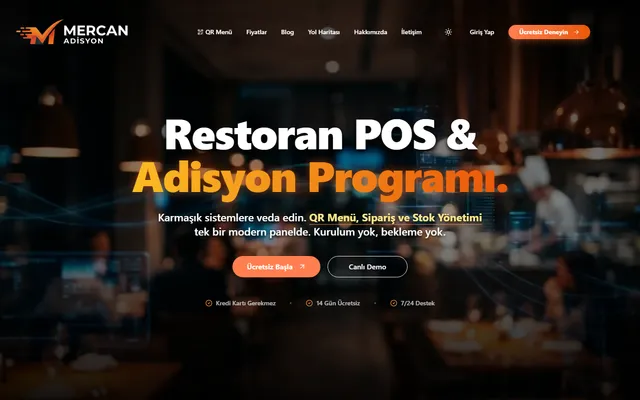
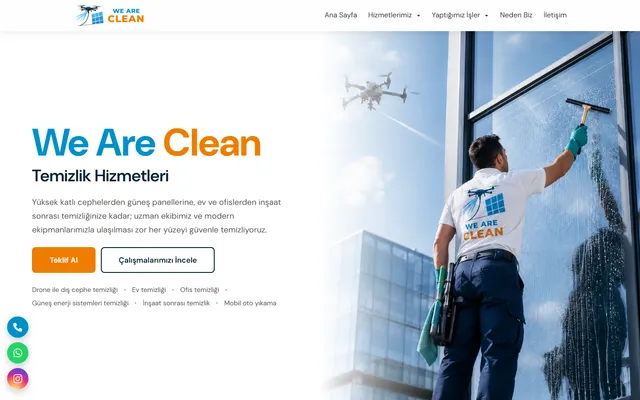
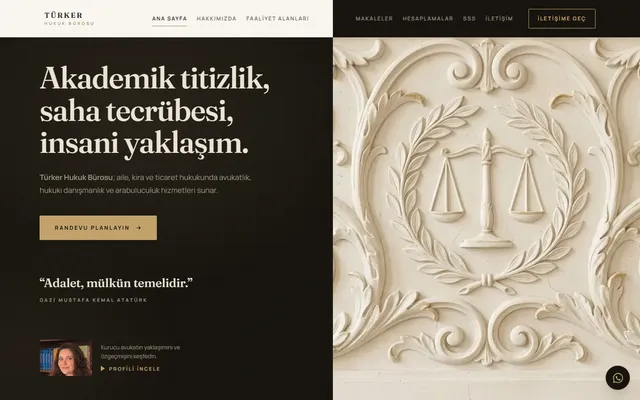
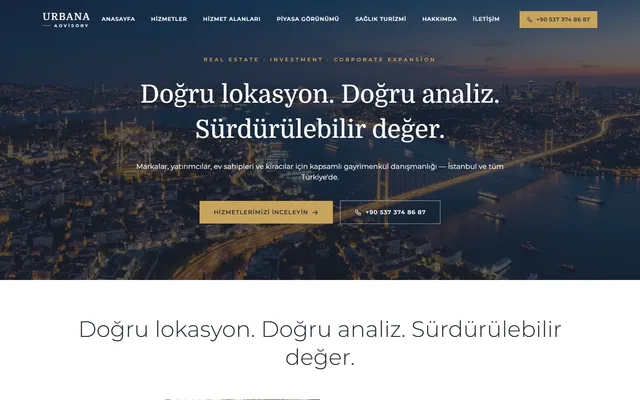
Browse sites we have built

Sites we designed and built for our clients. Switch between the tabs.

Web Packages With Clear Scope

Choose a starting package based on your page structure, content management and integration needs.

15% off campaignOn every package.

Digital Starter

15% off

Regular price: ₺9,500

Discounted price: ₺8,000One-time payment

Save ₺1,500

  • A modern web design that suits your brand and presents your business professionally.
  • A corporate site of up to 5 pages introducing your business and services.
  • A search-engine-friendly page structure that supports your discoverability on Google.
  • A structure that is comfortable to use on phone, tablet and desktop and focuses on loading quickly.
  • A contact form and WhatsApp link so visitors can easily request a quote.
  • Easy access to your business through phone, map and directions links.

Corporate Plus

15% off

Regular price: ₺24,500

Discounted price: ₺20,800One-time payment

Save ₺3,700

  • A comprehensive corporate site of up to 20 pages that presents your wide range of services in an organised way.
  • Two-language infrastructure that supports reaching your customers abroad.
  • Custom animations and carefully designed transitions that strengthen your brand’s presentation.
  • Service and content pages aiming for broader search coverage on Google.
  • Contact areas suited to each page’s purpose that guide visitors towards requesting a quote.
  • Advanced content management and admin panel training so you can use your site comfortably.

Prices are starting amounts excluding VAT. Domain and hosting are free for the first year; paid third-party services are quoted separately.

Your website is the first meeting with someone who doesn't know you yet. We turn that meeting into an enquiry.

Web design for businesses in Izmir

In and around Izmir we work with exporting producers, logistics companies and hospitality businesses. Part of that work appears on our project pages in as much detail as each client has agreed to, and we can point you to the closest examples on a first call.

  • What a foreign buyer is looking for

    A buyer landing on the site of a food or agricultural exporter did not come to see a photograph of the product. They are sourcing for a specific purchase and already have candidates in several countries. Whether you stay on the list or drop off it takes minutes.

    Read more

    What they look for in those minutes is predictable: product specifications, packaging and pallet detail, production capacity, the certifications you hold, minimum order quantity, delivery terms and how sampling works. When those are on the page, the first email you receive asks for a price rather than for information.

    The second factor is trust signals. A buyer abroad cannot walk into the plant, so plant photography, production line images, audit certificates and company details stand in for that visit. Without them, a capable producer is indistinguishable from an intermediary with no facility at all.

    Third is reachability: a direct line to the export department, the hours you can be reached and the languages you can answer in. Small details, but they work.

  • Multilingual is not a layer added at the end

    The mistake we correct most often in Izmir is an English version pasted on afterwards. Running Turkish copy through machine translation costs you credibility the moment a sector term comes out wrong, and in food and agriculture that risk is high, because product names, quality grades and packaging vocabulary are specific to the trade.

    Read more

    The technical side suffers too. URL structure, language switching, telling search engines which page belongs to which language and having content management carry both languages together all work properly when planned from the start. Added later they tend to be left half finished, with some pages untranslated and some links landing in the wrong language.

    How many languages you need depends on the target market. Turkish and English are enough for many exporters, while a company concentrated on one country may reasonably want a third. Every language is an additional maintenance burden, so we do not treat more as automatically better.

    You can supply the translation or commission it from us as a separate line. Either way, we recommend that someone on your side checks the sector terminology.

  • In hospitality the site is a path to a booking

    Along the Çeşme, Alaçatı and Selçuk line, guests decide fast and decide almost entirely from images. The highest-return investment here is therefore photography rather than design: a genuinely good property looks ordinary in badly lit pictures.

    Read more

    After the images the site has one job, which is shortening the path to a booking. Availability, room types, an honest sense of the price range and a contact channel one tap away. Long animated intros only slow down someone who arrived ready to decide.

    Booking platforms are a separate question. Most properties sell across several of them and let their own site sit in second place, yet a direct booking carries no commission, and that is where the site pays for itself. Encouraging direct bookings does not mean leaving the platforms.

    Seasonality shapes the plan as well. The site should be ready, the images refreshed and the content current before the season opens. Rebuilding mid-season is hard on everyone during the busiest weeks of the year.

  • Process, speed and handover

    The work runs in four stages: agreeing direction, putting scope and timeline in writing, production with visible checkpoints, then testing and launch. Each stage produces a document.

    Read more

    We build with Next.js, so pages are prepared on the server and arrive ready. That difference is more noticeable for visitors abroad, where distance already adds latency.

    Every site is built mobile-first and tested on real devices. In hospitality most traffic arrives from a phone, and even on the industrial side the first look is usually taken on one.

    Sites ship with an admin panel, so a new product, a renewed certificate or a set of season images does not require waiting on an agency. Domain and hosting are free for the first year for every website client, and we recommend registering both in your own name. Payment normally runs half up front and half on delivery.

Frequently Asked Questions

Common questions about website processes, delivery and technical infrastructure.

How many languages should our site have?

It depends on the target market. Turkish and English are enough for most exporters, while a company concentrated on one country may find a third language worthwhile. We do point out that each language is a maintenance burden: an untranslated or outdated language version looks worse than not having it at all.

Should we publish our product certifications?

In food and agricultural export this is close to decisive. Buyers want to see which audits you have passed without having to ask by email. Leaving those documents downloadable is one of the cheapest ways to shorten an evaluation. If some documents should not be public, we can hold them in a section shared on request.

Can you build a booking system?

It depends on scope. If you already use a booking or channel management system, connecting the site to it is usually the sounder route; building booking infrastructure from scratch is a separate project. We ask which systems you use on the first call and plan around that.

Can it be ready before the season?

We plan backwards from the season and say at the start what will and will not be ready. Photography, content preparation and translation finish on different timelines. If the date is close, publishing the most critical sections first is often more sensible than pushing the whole site, and we work that out together.

Can we meet in Izmir?

We do not keep a physical office in Izmir; the work runs remotely and we say so up front. The process runs in writing: a scope document, live previews at checkpoints and feedback that is recorded rather than remembered. In practice that is more traceable than a project run verbally in the same city.

Want to work with us?

I want to work with you